Amazon Hits 1.5°C Above Historical Average, Reaching Paris Agreement Threshold
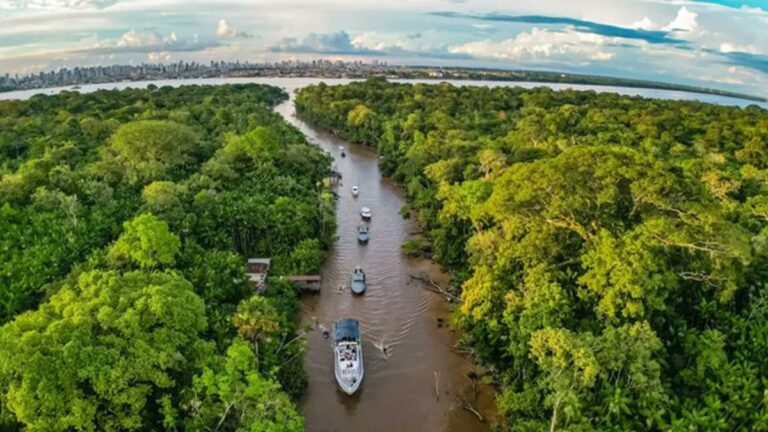
A view of the Brazilian Amazon, Nov. 2025. X/ @amadomundo_
November 5, 2025 Hour: 11:05 am
🔗 Comparte este artículo
Deforestation and global warming have pushed Brazilian biomes beyond critical temperature limits.
On Wednesday, the MapBiomas network published a study showing that the average temperature in the Brazilian Amazon reached 1.5°C above the historical average in 2024, hitting the maximum threshold set by the Paris Agreement.
RELATED:
Indigenous-Led Flotilla Crosses the Amazon Demanding Climate Justice
In the Pantanal, another of the country’s main biomes, the temperature exceeded the limit by rising 1.8°C, after experiencing 205 consecutive days without rain last year.
The Paris Agreement, signed in 2015 by 197 countries, sets a global goal of limiting the planet’s temperature increase to below 2°C, with an emphasis on not surpassing 1.5°C — a threshold experts consider crucial to preventing severe climate impacts, such as extreme weather events.
Deforestation Among the Main Causes
The study reports that the Brazilian Amazon lost 52 million hectares of native vegetation between 1985 and 2024. During that period, the biome’s average temperature rose by 1.2°C. Nationwide, the increase occurred at an average rate of 0.29°C per decade.
The Pantanal showed the fastest rate of warming, with an increase of 0.47°C per decade, followed by the Cerrado, which rose by 0.31°C in the same period. In contrast, coastal biomes such as the Atlantic Forest and the Pampa recorded more moderate rates (+0.21°C and +0.14°C, respectively).
MapBiomas coordinator Tasso Azevedo said recent studies show that “deforestation alters the exchange of heat and water vapor with the atmosphere,” which causes temperatures to rise.
Luiz Toledo Machado, a professor at the Sao Paulo University and member of the MapBiomas team, explained that although deforestation is one of the causes, the temperature increase “is mainly due to global climate change,” driven by the accumulation of greenhouse gases. “Amazon’s deforestation contributes 16.5% of total warming and 74.5% of rainfall reduction during the dry season,” he added.
The Most Severe Climate Crisis in Four Decades
According to the analysis, Brazil experienced its highest thermal anomaly in 2024 since 1985, with temperatures 1.2°C above the average.
All 27 Brazilian states recorded temperatures between 0.3°C and 2.0°C above their historical averages. Roraima, located in the northern Amazon region bordering Venezuela, was the most affected.
Regarding rainfall, the study found that while Rondônia, which borders Bolivia, saw 36% less precipitation than average, the southern state of Rio Grande do Sul — bordering Argentina and Uruguay — experienced 19% more than the average, with unprecedented floods that killed more than 180 people and displaced nearly 700,000.
In the Brazilian Amazon, the dry season between July and September fueled wildfires that last year destroyed 15.6 million hectares of vegetation. Currently, the MapBiomas Atmosphere platform provides data on temperature, precipitation, and air pollution from 1985 to 2024, based on satellite imagery and data modeling.
teleSUR/ JF
Source: EFE